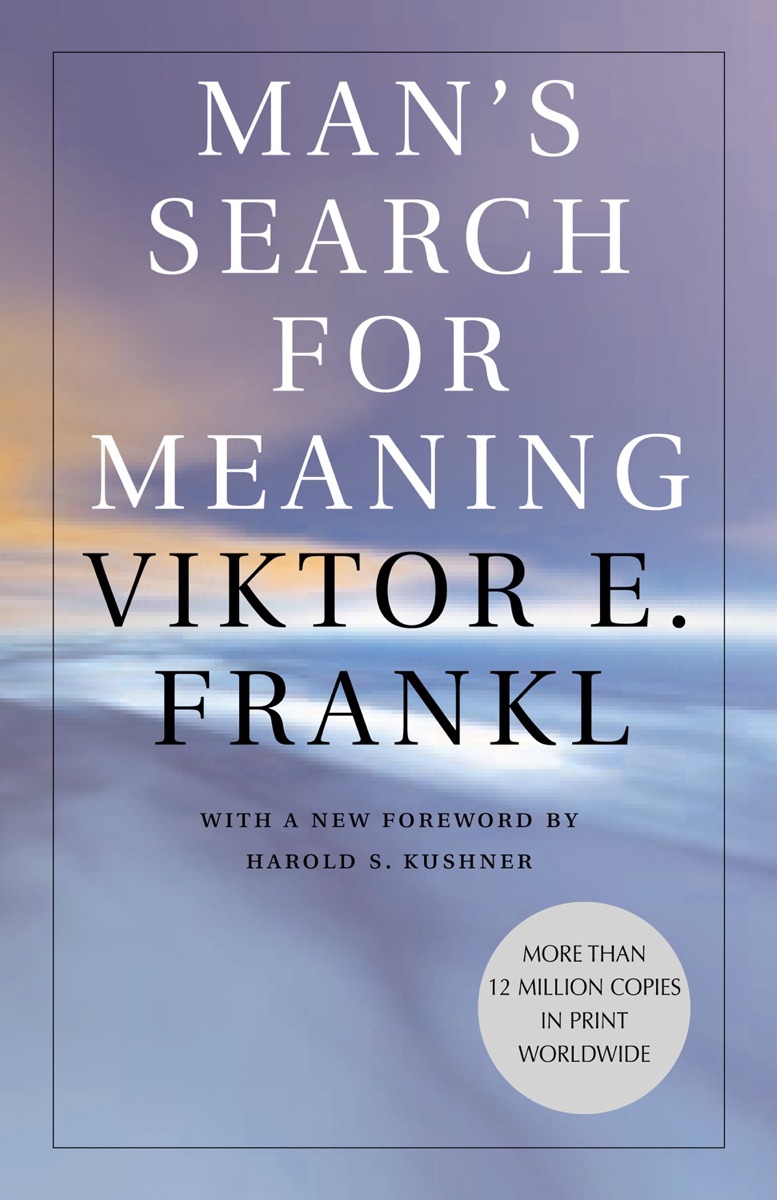
Man's Search for Meaning
Viktor E. Frankl
My take
This book split open a question I thought I’d already answered. Most personal development material tells you to chase happiness or set goals or optimise your routines. Frankl, writing from inside a concentration camp, makes a completely different claim: the primary drive in a human being isn’t pleasure and isn’t power. It’s meaning. And meaning doesn’t come from comfort. It comes from the stance you take toward whatever life hands you, including suffering. The part that stuck with me most was his insistence that life is the one asking the questions, not you. You don’t get to sit back and demand “what’s the point?” You get asked, daily, by every situation you face, and you answer with your actions. That reframe changed the way I approach hard seasons. I stopped asking why and started asking what this is asking of me.
Core insight 1: The last freedom no one can take
Frankl watched everything stripped away from human beings: their homes, their families, their names, their dignity. What he found was that even in the most extreme conditions, one thing remained. The freedom to choose your own response. Not your circumstances, not your body, not your future, but your inner attitude toward all of it. This is the insight the entire book orbits.
Everything can be taken from a man but one thing: the last of the human freedoms, to choose one’s attitude in any given set of circumstances, to choose one’s own way.
How to practice: The next time something outside your control frustrates you, pause before reacting. Notice the gap between what happened and how you respond. That gap is your freedom. Widen it.
Core insight 2: Meaning can’t be invented, only discovered
Frankl is precise about this. You don’t get to manufacture meaning by sitting in a room and brainstorming your purpose. Meaning is found in three places: in the work you do (creating or contributing something), in the love you experience (caring for another person deeply), and in the courage you bring to unavoidable suffering. The third one is the hardest and most original. He’s saying that even when nothing else is available, meaning is still possible.
As each situation in life represents a challenge to man and presents a problem for him to solve, the question of the meaning of life may actually be reversed. Ultimately, man should not ask what the meaning of his life is, but rather he must recognize that it is he who is asked.
How to practice: Stop asking “what is my purpose?” for a week. Instead, ask: “what is being asked of me right now, by the people in my life, by the work in front of me, by the difficulty I’m facing?”
Core insight 3: Happiness can’t be pursued directly
This is one of those ideas that sounds simple until you realize how thoroughly you’ve been violating it. Frankl’s observation is that the harder you chase happiness, the more it recedes. It only shows up as a side effect: of dedicating yourself to a cause larger than yourself, or of surrendering to another person in love. The moment you make happiness the target, you miss. It has to ensue, not be pursued.
Don’t aim at success. The more you aim at it and make it a target, the more you are going to miss it. For success, like happiness, cannot be pursued; it must ensue, and it only does so as the unintended side effect of one’s personal dedication to a cause greater than oneself or as the by-product of one’s surrender to a person other than oneself.
How to practice: Check your goals. How many of them are framed as “I want to feel X”? Reframe each one as a contribution: what can I give, build, or serve? Let the feeling arrive on its own.
Core insight 4: Suffering without meaning is unbearable, suffering with meaning is transformative
Frankl isn’t glorifying pain. He’s making a precise clinical observation: suffering that has no meaning attached to it crushes people. But the same suffering, when a person finds a reason inside it, becomes bearable and sometimes even a source of growth. The deciding factor isn’t the intensity of the pain. It’s whether the person can locate a “why” within it. Nietzsche’s line echoes through the whole book: he who has a why can bear almost any how.
In some ways suffering ceases to be suffering at the moment it finds a meaning, such as the meaning of a sacrifice.
Those who have a “why” to live, can bear with almost any “how.”
How to practice: If you’re going through a hard stretch, don’t try to make it feel better. Try to make it mean something. Ask: what is this teaching me? What is this preparing me for? What would I become if I let this sharpen me instead of break me?
Core insight 5: Love reaches beyond the physical
The most personal passage in the book is when Frankl, marching in frozen darkness, conjures the image of his wife so vividly that it sustains him. He realizes that love doesn’t need the other person to be present, or even alive. It reaches into the essence of who they are, into their potential, into what they could become. This isn’t romantic idealism. It’s a survival mechanism. Love gave him a reason to keep walking.
Love is the only way to grasp another human being in the innermost core of his personality. No one can become fully aware of the very essence of another human being unless he loves him.
How to practice: Think about someone you love. Not what they do for you, not how they make you feel, but who they are becoming. That vision of their potential is a form of love that doesn’t depend on proximity.
Core insight 6: Self-actualization is a side effect of self-transcendence
This is Frankl’s direct challenge to the entire self-help industry. You don’t become your best self by focusing on yourself. You become your best self by focusing on something beyond yourself: a mission, a person, a contribution. The more you try to “find yourself,” the more you circle inward. The more you give yourself to something that matters, the more you actually become.
The more one forgets himself, by giving himself to a cause to serve or another person to love, the more human he is and the more he actualizes himself. What is called self-actualization is not an attainable aim at all, for the simple reason that the more one would strive for it, the more he would miss it. In other words, self-actualization is possible only as a side-effect of self-transcendence.
How to practice: Audit your current priorities. How much energy goes into self-improvement versus contribution? Shift one hour this week from optimising yourself to serving someone else.
Core insight 7: You are always self-determining
Frankl ends the book with a statement that sounds simple and lands like a hammer. A human being is not a thing shaped entirely by genetics and environment. You are, within the limits of your situation, the author of what you become. This isn’t naive optimism. It’s a conclusion drawn from watching people in the worst conditions imaginable make radically different choices about who they would be.
A human being is not one thing among others; things determine each other, but man is ultimately self-determining. What he becomes, within the limits of endowment and environment, he has made out of himself.
How to practice: Notice the next time you say “I had no choice.” You probably did. It just wasn’t the easy one.
This is not a productivity book or a motivation book. It’s a book about what holds a person together when everything external falls apart. Read it once to understand the ideas. Then live with it. The real value shows up in the moments where you’re tempted to collapse into meaninglessness, and you remember that meaning isn’t something you’re owed. It’s something you answer.
Other reminders
So live as if you were living already for the second time and as if you had acted the first time as wrongly as you are about to act now!
No man should judge unless he asks himself in absolute honesty whether in a similar situation he might not have done the same.
It is well known that humor, more than anything else in the human make-up, can afford an aloofness and an ability to rise above any situation, even if only for a few seconds.
Man does not simply exist but always decides what his existence will be, what he will become the next moment. By the same token, every human being has the freedom to change at any instant.
It is not freedom from conditions, but it is freedom to take a stand toward the conditions.
Everyone has his own specific vocation or mission in life; everyone must carry out a concrete assignment that demands fulfillment. Therein he cannot be replaced, nor can his life be repeated. Thus, everyone’s task is unique as is his specific opportunity to implement it.
A man who becomes conscious of the responsibility he bears toward a human being who affectionately waits for him, or to an unfinished work, will never be able to throw away his life. He knows the “why” for his existence, and will be able to bear almost any “how.”
In spite of all the enforced physical and mental primitiveness of the life in a concentration camp, it was possible for spiritual life to deepen.
Enjoyed this? You'll like Open Loops.
Every week I share ideas on clarity, growth, and building a life that feels like yours. Join 3K+ readers.
You might also like