
My take
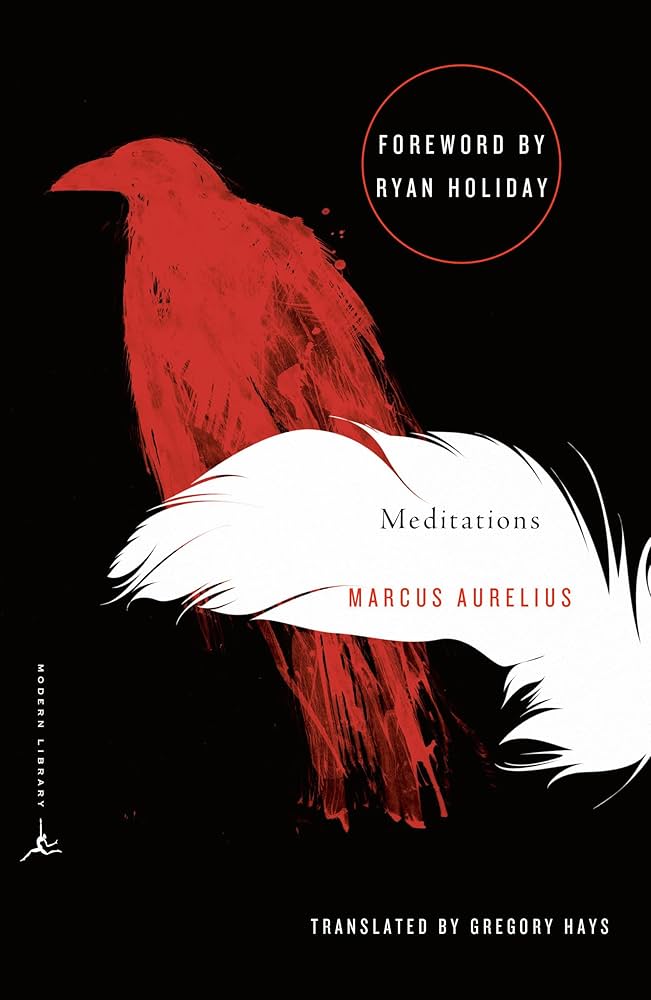
If someone asks me to recommend one book, this is it. Every time. It’s the one I keep coming back to, the one that somehow captures what dozens of other books try to say in hundreds of pages. But what makes Meditations different is what it was never supposed to be. Marcus Aurelius didn’t write this for you. He wrote it for himself. A private journal from the most powerful man in the ancient world, dealing with war, plague, betrayal, and the weight of empire, choosing every morning to focus on what was within his control. That’s what hits hardest: not the wisdom itself, but knowing it came from someone who had every reason to complain and every power to force his will on the world, yet chose to work on himself instead. These are the ideas that have stayed with me the most.
Core insight 1: You control your response, not the world
This is the foundation of everything in this book. External events have no power over you. Only your interpretation of them does.
External things are not the problem. It’s your assessment of them. Which you can erase right now.
Nothing that goes on in anyone else’s mind can harm you. Nor can the shifts and changes in the world around you. Then where is harm to be found? In your capacity to see it. Stop doing that and everything will be fine.
Most frustration comes from expecting the world to behave differently than it does. Marcus keeps returning to one principle: you cannot control what happens, but you can always control how you respond. That choice is where your freedom lives.
How to practice: When you feel reactive, pause and separate the event from your story about the event. Ask: “Is this actually harming me, or am I choosing to see it as harmful?” The judgment is always optional.
Core insight 2: Your thoughts shape your reality
What you feed your mind is what your life becomes. Not eventually. Right now.
The things you think about determine the quality of your mind. Your soul takes on the color of your thoughts.
Don’t waste the rest of your time here worrying about other people, unless it affects the common good. It will keep you from doing anything useful. You’ll be too preoccupied with what so-and-so is doing, and why, and what they’re saying, and what they’re thinking.
This isn’t positive thinking. It’s a warning. If you spend your mental energy on gossip, comparison, or resentment, your mind becomes gossip, comparison, and resentment. You don’t just have thoughts. You become them.
How to practice: Audit what occupies your mind throughout the day. If most of your thinking is about other people’s behavior, that’s a signal. Redirect toward your own actions, your own work, your own growth.
Core insight 3: Time is short, act now
Marcus returns to urgency more than any other theme. Not the frantic kind. The quiet, honest acknowledgment that you will die, and most of what you worry about won’t matter.
This is what you deserve. You could be good today. But instead you choose tomorrow.
Stop drifting. You’re not going to re-read your Brief Comments, your Deeds of the Ancient Greeks and Romans, the commonplace books you saved for your old age. Sprint for the finish. Write off your hopes, and if your well-being matters to you, be your own savior while you can.
Life is short. That’s all there is to say. Get what you can from the present, thoughtfully, justly. Unrestrained moderation.
The reminder isn’t morbid. It’s clarifying. When you remember that your time is limited, you stop wasting it on things that don’t matter. You stop postponing the work, the conversation, the change.
How to practice: Start each day by acknowledging it could be your last. Not as a dramatic exercise, but as a filter. Ask: “If this were my last day, would I spend it doing what I’m about to do?”
Core insight 4: Don’t tie your well-being to others’ opinions
One of the sharpest distinctions in the book. Marcus draws a clear line between ambition, self-indulgence, and sanity.
Ambition means tying your well-being to what other people say or do. Self-indulgence means tying it to the things that happen to you. Sanity means tying it to your own actions.
Beautiful things of any kind are beautiful in themselves and sufficient to themselves. Praise is extraneous. The object of praise remains what it was, no better and no worse.
The tranquillity that comes when you stop caring what they say. Or think, or do. Only what you do.
If your mood depends on someone else’s approval, you’ve handed them your peace. Marcus isn’t saying you shouldn’t care about people. He’s saying your self-worth should come from your own actions, not their applause.
How to practice: Notice when you’re performing for an audience, even an imaginary one. Do the work because it’s the right thing to do, not because someone might notice. Beautiful things don’t need praise to be beautiful.
Core insight 5: Do the essential, not everything
Marcus was running an empire, yet his advice isn’t about getting more done. It’s about doing less, better.
“If you seek tranquillity, do less.” Or (more accurately) do what’s essential, what the logos of a social being requires, and in the requisite way. Which brings a double satisfaction: to do less, better.
A key point to bear in mind: The value of attentiveness varies in proportion to its object. You’re better off not giving the small things more time than they deserve.
This is essentialism before the word existed. Not every task deserves your full attention. Not every problem deserves a response. The discipline is in choosing what matters and letting everything else go.
How to practice: Before starting any task, ask: “Does this deserve my full attention, or am I giving it more time than it’s worth?” Protect your best energy for the work that actually matters.
Core insight 6: Stand erect on your own
Marcus circles back to self-reliance throughout the journal. Not the isolated kind. The grounded kind, where you stop needing external validation to feel okay.
You don’t love yourself enough. Or you’d love your nature too, and what it demands of you. People who love what they do wear themselves down doing it, they even forget to wash or eat. Do you have less respect for your own nature than the engraver does for engraving, the dancer for the dance, the miser for money or the social climber for status?
Not to assume it’s impossible because you find it hard. But to recognize that if it’s humanly possible, you can do it too.
Self-reliance here isn’t about doing everything alone. It’s about not needing someone else to hold you up. Your stability comes from within, from knowing who you are and acting accordingly.
How to practice: When you feel the pull of people-pleasing or approval-seeking, return to the question: “Am I doing this because it’s right, or because I want someone to notice?” Act from conviction, not from hunger.
Core insight 7: See things as they are
Marcus uses a technique that sounds almost absurd at first: strip away the labels and see the raw reality underneath.
Like seeing roasted meat and other dishes in front of you and suddenly realizing: This is a dead fish. A dead bird. A dead pig. Or that this noble vintage is grape juice, and the purple robes are sheep wool dyed with shellfish blood.
When you face someone’s insults, hatred, whatever, look at his soul. Get inside him. Look at what sort of person he is. You’ll find you don’t need to strain to impress him.
This isn’t cynicism. It’s clarity. When you strip away the glamour, the status, the story, you see what’s actually in front of you. And what’s actually in front of you is almost never as impressive or as threatening as the narrative your mind built around it.
How to practice: When something intimidates or tempts you, describe it in its simplest physical terms. A fancy dinner is cooked food. A prestigious title is a word someone assigned. The practice loosens the grip of illusion.
These seven ideas run through every page of Meditations, repeating and overlapping because Marcus needed the reminders. That’s the most human part of this book. He wasn’t writing from a place of mastery. He was writing from a place of practice, returning to the same principles every morning because the world kept testing him. If an emperor needed daily reminders to stay grounded, the rest of us probably do too.
Other reminders
Perfection of character: to live your last day, every day, without frenzy, or sloth, or pretense.
No matter what anyone says or does, my task is to be good. Like gold or emerald or purple repeating to itself, “No matter what anyone says or does, my task is to be emerald, my color undiminished.”
When you wake up in the morning, tell yourself: The people I deal with today will be meddling, ungrateful, arrogant, dishonest, jealous, and surly. They are like this because they can’t tell good from evil.
I was once a fortunate man but at some point fortune abandoned me. But true good fortune is what you make for yourself. Good fortune: good character, good intentions, and good actions.
Not to live as if you had endless years ahead of you. Death overshadows you. While you’re alive and able, be good.
Treat what you don’t have as nonexistent. Look at what you have, the things you value most, and think of how much you’d crave them if you didn’t have them.
Forget everything else. Keep hold of this alone and remember it: Each of us lives only now, this brief instant. The rest has been lived already, or is impossible to see.
It doesn’t bother you that you weigh only x or y pounds and not three hundred. Why should it bother you that you have only x or y years to live and not more? You accept the limits placed on your body. Accept those placed on your time.
People who labor all their lives but have no purpose to direct every thought and impulse toward are wasting their time, even when hard at work.
If anyone can refute me, show me I’m making a mistake or looking at things from the wrong perspective, I’ll gladly change. It’s the truth I’m after, and the truth never harmed anyone. What harms us is to persist in self-deceit and ignorance.
Enjoyed this? You'll like Open Loops.
Every Thursday, I share what I’m learning about growth, work, and the long game. Join 3K+ readers.
You might also like