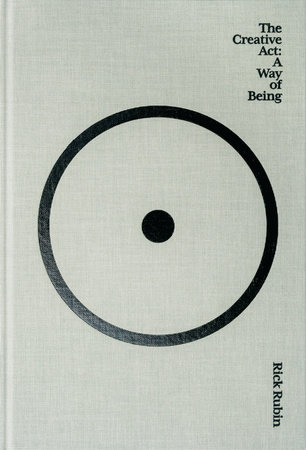
The Creative Act
Rick Rubin
My take
This book didn’t teach me anything new. That’s the highest compliment I can give it. Rick Rubin put language to something I’d been circling for years but couldn’t name: creativity is not a skill you train or a talent you’re born with. It’s a way of being you either honor or ignore. I picked it up expecting craft advice. What I got was permission to stop treating creativity like something separate from who I already am. That shift changed how I show up to every project, every piece of writing, every conversation. The Creative Act reframes creativity from something you do to something you are. You don’t need special talent or training to create. You need presence, curiosity, and the willingness to show up.
Core insight 1: Ideas exist in the aether
Ideas aren’t possessions but signals in collective consciousness waiting for expression. When you feel drawn to create something, it’s your turn to channel it. If you don’t act, the idea will find another creator.
“If you have an idea you’re excited about and you don’t bring it to life, it’s not uncommon for the idea to find its voice through another maker. This isn’t because the other artist stole your idea, but because the idea’s time has come. In this great unfolding, ideas and thoughts, themes and songs and other works of art exist in the aether and ripen on schedule, ready to find expression in the physical world.”
This perspective releases attachment to ownership and emphasizes responding to creative impulses when they appear.
How to apply it: Trust timing, don’t wait for perfect conditions, release ownership attachment, and pay attention to recurring ideas.
Core insight 2: The gap between imagination and reality
The finished work inevitably feels smaller than the boundless mental vision because imagination lacks constraints while physical reality doesn’t. This gap isn’t failure, it’s where genuine creation occurs.
“Turning something from an idea into a reality can make it seem smaller. It changes from unearthly to earthly. The imagination has no limits. The physical world does. The work exists in both.”
Constraints become creative fuel rather than obstacles. The imagination has no limits. The physical world does. The work exists in both.
How to apply it: Accept this natural gap, use limitations as creative tools, let work become what it wants to be, and honor both vision and execution.
Core insight 3: It’s about feeling, not knowing
Analytical thinking judges and constrains work, but authentic creation emerges from bodily sensation and intuition. Physical signals, excitement, energy, aliveness, guide better than mental reasoning. But creativity doesn’t live in your head. It lives in your body.
“It’s not about knowing. It’s all about feeling and noticing what’s happening in your body. If it’s exciting to you, it’s likely that it’ll be exciting to someone else.”
Practices: Notice bodily responses while creating, prioritize feeling over logical judgment, move your body when stuck, and trust what makes you feel alive.
Core insight 4: Lower the stakes
The pressure to make something great is what kills most creative projects before they start. Starting with exploration rather than ambition produces better work. Create for yourself first; if you love it, others likely will too.
Start with curiosity, not ambition.
Practical takeaways: Begin with curiosity not ambition, make for yourself initially, remember the work’s modest scope, and focus on process over outcome.
Core insight 5: Success is in the release
Success occurs when you complete and release work, not through subsequent reception. Views, sales, and recognition depend on external factors beyond your control. The moment you finish something and send it out into the world. That’s it. That’s the win.
“Success happens when you sign off on a finished thing and say, okay, send it out into the world. That’s the moment of success. Once that happens, you look back onto the next. Because that’s the only part you have any participation in. That’s the only part you can control.”
Action steps: Define success as completion and release, let go of post-release outcomes, move quickly to next projects, and control only what you can control.
Core insight 6: Create from authenticity, not audience
Paradoxically, serving audiences means ignoring what they might want and creating what genuinely excites you. Authentic work resonates more than calculated audience-pleasing. You cannot fake authenticity.
“The audience comes last in service to the audience. The audience wants the best thing. They don’t get the best thing while you’re trying to service them. They get the best thing when you’re servicing yourself.”
The things you truly believe in, the things that really feel like something to you, other people resonate with.
What to do: Stop guessing audience preferences, trust genuine excitement translates to others, be yourself rather than a perceived audience expectation, and maintain authenticity throughout.
Core insight 7: Presence over perfection
Creation requires presence in the current moment. Thinking about how things “should be” or “might turn out” disconnects you from what’s actually happening. Presence enables receiving and channeling ideas.
Practices: Practice breathing and grounding before creating, release preconceived notions about outcomes, trust the process without needing direction, and work from curiosity rather than certainty.
Core insight 8: Embrace imperfection
Pursuing flawlessness removes the quirks that make work distinctly yours. Imperfections provide character and humanity. What seems like mistakes may be exactly what the work needs.
Practices: Don’t eliminate all flaws, allow work to be humanly imperfect, trust apparent mistakes, and recognize that imperfection creates interest.
The Creative Act reframes creativity from a skill you learn to a way of being you already have. These insights aren’t about becoming an artist, they’re about recognizing that you’re already creative, already capable, already enough.
The work isn’t about perfection or ownership or external validation. It’s about showing up, paying attention, and trusting the process. When you lower the stakes, create from feeling, and embrace imperfection, you’re not just making things. You’re living the creative act itself. That’s the shift. That’s what changes everything.
Other reminders
The best work is the work that comes through you, not from you.
To live as an artist is a way of being in the world. A way of perceiving. A practice of paying attention.
Look for what you notice but no one else sees.
Art is a circulation of energies. What comes through depends on how open you are to receiving.
Enjoyed this? You'll like Open Loops.
Every Thursday, I share what I’m learning about growth, work, and the long game. Join 3K+ readers.
You might also like