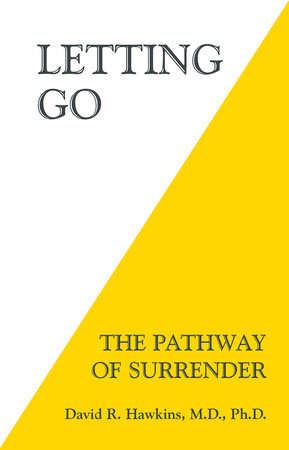
Letting Go: The Pathway To Surrender
David R. Hawkins
My take
I picked this up in a stretch of life where I had become very good at managing my feelings, and very bad at actually feeling them. Hawkins names the trap immediately: there are only three ways most of us handle an emotion, and all three are forms of running. Suppress it, express it, or escape it. None of them dissolve it. The book is essentially a fourth option. Stop strategising. Let the feeling be there, drop the resistance to it, and watch what happens. The radical claim is that emotions stuck for years can release in minutes when you stop fighting them. I was sceptical at first, then I tried it on a single feeling I had been carrying for a decade. He was right. The book is dense and a little dated in its language, but the technique is real, and the map of consciousness it builds is one of the more useful frameworks I have for tracking my own inner state. This is a book to do, not just read.
Core insight 1: The three ways you handle emotions are all forms of avoidance
Suppress, express, escape. Notice that you have probably been cycling through these your entire life. You push it down (suppress). You let it explode (express). You distract yourself with food, work, scrolling, sex (escape). Each one feels like dealing with the emotion. None of them actually move it through you. Hawkins’ whole project is the alternative: a fourth move that nobody taught you.
Recall the usual mechanisms that the mind consciously uses to handle emotions, which are suppression (or repression), expression, and escape.
How to practice: Catch yourself mid-cycle today. Which of the three are you running? You don’t have to do anything different yet. Just see the pattern. Awareness is the first crack in it.
Core insight 2: Letting go is a technique, not a mood
The instruction is mechanical and specific. You feel the feeling fully, you stop resisting it, and you stop labelling it. You don’t analyse it, journal it, talk about it, or try to fix the situation that caused it. You just sit with the raw sensation in your body until it loses its charge. The first few times feel impossible because you have decades of muscle memory pulling you toward suppression, expression, or escape. With practice it becomes a tool you can reach for in seconds.
When you let go of resistance to a feeling, the feeling itself diminishes and eventually releases its energy.
How to practice: Pick one small irritation today (someone cuts you off in traffic, a slow elevator). Don’t react. Don’t think about it. Just feel the irritation in your body until it passes. That’s the entire technique, scaled down.
Core insight 3: Most lifetime patterns release faster than you think
The thing that surprised me most was Hawkins’ claim, repeated and validated by his patients, that decades of inhibition or fear can dissolve in minutes once the resistance is dropped. We carry suffering for so long that we assume it must take just as long to undo. It doesn’t. The reason it stayed isn’t the depth of the wound. It’s the continuous resistance to feeling it.
One surprising observation about the mechanism of letting go is that major changes can take place very rapidly. Lifetime patterns can suddenly disappear, and long-standing inhibitions can be let go of in a matter of minutes, hours, or days.
How to practice: Pick the oldest emotional pattern you can name. Resist the urge to think you need years of therapy to address it. Try the technique on it for fifteen minutes. Some things that have been with you forever are lighter than you think.
Core insight 4: Mastery over feelings is mastery over fear
Once you know you can sit with any feeling without it destroying you, fear loses most of its grip. Most of what we call fear is actually fear of how we will feel if X happens. Take away the fear of the feeling and the original fear shrinks dramatically. This is why the technique generalises so widely. You’re not fixing one emotion at a time. You’re rewiring the underlying assumption that feelings are dangerous.
Once we have mastery over our feelings, our fear of life diminishes. We feel a greater self-confidence, and we are willing to take greater chances because we now feel that we can handle the emotional consequences, whatever they might be.
How to practice: Next time you avoid a hard conversation or a risky move, ask: what feeling am I actually trying to dodge? Sit with that feeling first. Then make the call.
Core insight 5: Stop resisting the positive emotions too
This one was the unlock for me. We work hard on releasing anger, fear, grief. But we resist joy, love, and aliveness just as much, often more, because they make us vulnerable. The same letting-go move applies. Stop pushing the good ones away. Notice when you minimise a compliment, deflect affection, or rush past a moment of beauty. Those are also resistances.
The corollary to letting go of negative feelings is to stop resisting the positive ones. Everything in the universe has its opposite; therefore, in the mind, every negative feeling has its counterpart.
How to practice: When something good happens today, even small, let it land for ten extra seconds before you move on. Notice the impulse to deflect or move past it. That impulse is the resistance.
Core insight 6: Your inner state is broadcast, whether you intend it or not
Hawkins makes the case that feelings carry energy and that energy radiates. The room reads it before your words do. The people you love feel it before you speak. Your work culture absorbs it. This isn’t woo. It’s the practical observation that we are all unconsciously calibrating to each other’s nervous systems all day long. Which means cleaning up your inner state is one of the most generous things you can do for the people around you.
Our inner states are actually radiated to others. We can positively affect others even when we are not physically with them. Feelings are energy and all energy gives off a vibration.
How to practice: Before any meeting or conversation that matters, take sixty seconds. Don’t rehearse what to say. Just notice and release whatever you’re carrying. Walk in clean.
Core insight 7: What you hold in mind tends to manifest
This is the line that sounds the most “law of attraction” and is the hardest to take seriously, until you watch it operate in your own life for a few months. It isn’t magic. The thoughts you give consistent energy to shape what you notice, what you pursue, what you say yes and no to, and how others read you. Reality bends to attention over time.
What one holds in mind tends to manifest. Any thought which we consistently hold in mind and consistently give energy to will tend to come into our life according to the very form in which our mind has held it.
How to practice: Audit what you’ve been holding in mind on autopilot for the last month. That’s the field you’ve been planting. If you don’t like the harvest coming, change what you’re feeding.
Core insight 8: Who you become matters more than what you do
The final reframe. Most of us optimise for accomplishments and acquisitions. Hawkins’ observation, after decades with patients, is that beyond a baseline, none of it lands the way you think it will. What people end up wanting from you, and what you end up wanting from yourself, is your presence. The quality of what it feels like to be near you. That’s almost entirely a function of inner state, which is almost entirely a function of how much you have let go.
People now seek our company, not because of what we have, not because of what we do and society’s labels, but because of what we have become. Because of the quality of our presence, people just want to be around us and experience us.
How to practice: Stop asking what you should do next. Ask who you are becoming through what you do next. The answer changes which next.
This isn’t a book you finish. It’s a book you keep coming back to as a manual. Read it once for the framework. Then practice the technique on real feelings as they arise, for months. The change is cumulative and quiet, until one day you notice you’re carrying a lot less than you used to.
Other reminders
The part of us that wants to cling to negative emotions is our smallness. It is the part of us that is mean, petty, selfish, competitive. It has little energy. It is depleting. It is the small part of us that accounts for our own self-hatred and seeking for punishment.
The “dark night of the soul” frequently precedes states of heightened awareness.
A good and very illuminating exercise is to sit down and look at the feeling that is directly opposite the negative one you are experiencing, and begin to let go of resisting it.
Self-awareness is increased much more rapidly by observing feelings rather than thoughts. The thoughts associated with even one feeling may run into the thousands.
The world can only see us as we see ourselves.
Depression and apathy result from the willingness to hang on to the small self and its belief systems, plus the resistance to our Higher Self.
When that inner emptiness is replaced by true self-love, self-respect and esteem, we no longer have to seek it in the world. That source of happiness is within ourselves.
Greatness is the courage to overcome obstacles. It is the willingness to move to a higher level of love. It is the acceptance of others’ humanness and having compassion for their suffering by putting ourselves in their shoes.
Enjoyed this? You'll like Open Loops.
Every week I share ideas on clarity, growth, and building a life that feels like yours. Join 3K+ readers.
You might also like