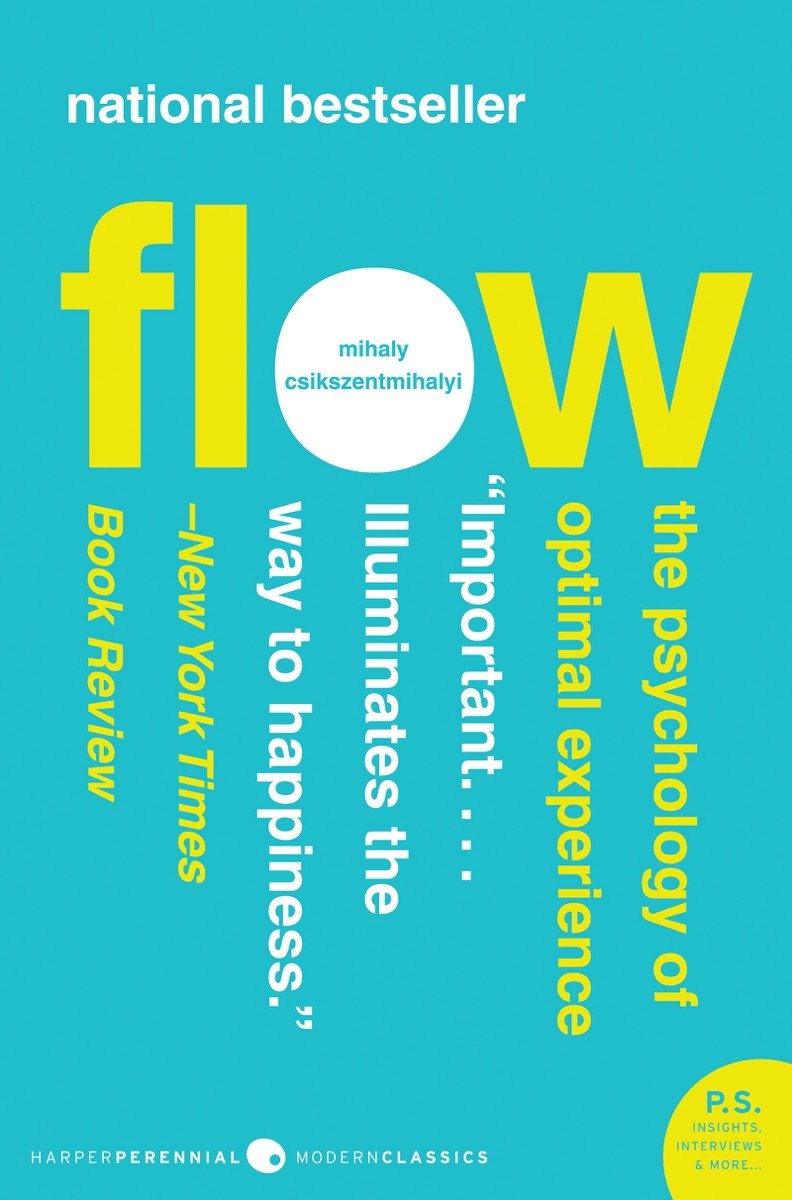
Flow
Mihaly Csikszentmihalyi
My take
Most books about happiness tell you what to pursue. This one tells you what happens inside when you stop chasing and start engaging. Csikszentmihalyi spent decades studying what he calls “optimal experience,” and the conclusion is deceptively simple: the best moments in life are not the easy ones. They’re the ones where your attention is fully invested in something difficult and worthwhile, where skills and challenge are matched just tightly enough that everything else falls away. He calls this state “flow,” and the insight that changed how I think about my days is that flow is not something that happens to you. It’s something you create by how you direct your attention. Consciousness is not a passenger. It’s the driver. And most of us hand the wheel to whatever is loudest, most urgent, or most comfortable instead of choosing deliberately. The book reframes happiness from a thing you find to a thing you build, one focused hour at a time.
Core insight 1: The quality of your life depends on the quality of your attention
This is the book’s thesis and it holds up against everything. Not your circumstances, not your income, not your location. What determines how your life feels is how your mind filters and interprets what’s happening. Two people in identical situations can have radically different experiences because one has learned to order consciousness and the other has not.
Control of consciousness determines the quality of life.
People who learn to control inner experience will be able to determine the quality of their lives, which is as close as any of us can come to being happy.
How to practice: For one day, track where your attention actually goes, not where you think it goes. You’ll find hours leaking into reactions, worries, and noise. The gap between where your attention is and where you want it to be is the gap between how your life feels and how it could feel.
Core insight 2: The best moments require effort, not ease
The cultural assumption is that happiness lives in relaxation, in weekends, in the absence of challenge. Csikszentmihalyi’s data says the opposite. The most satisfying moments people report are when they’re stretched to their limits in a voluntary effort to accomplish something that matters. Not forced labor. Chosen difficulty.
The best moments in our lives are not the passive, receptive, relaxing times. The best moments usually occur when a person’s body or mind is stretched to its limits in a voluntary effort to accomplish something difficult and worthwhile.
Most enjoyable activities are not natural; they demand an effort that initially one is reluctant to make. But once the interaction starts to provide feedback to the person’s skills, it usually begins to be intrinsically rewarding.
How to practice: Identify one area where you’ve been defaulting to comfort, whether it’s always consuming instead of creating, or choosing the familiar over the challenging. Replace one “easy” hour this week with a stretch. Not as punishment. As an experiment in where satisfaction actually lives.
Core insight 3: Flow is not a mood, it’s a structure
Flow has clear conditions: a goal you care about, immediate feedback on your progress, and a challenge that matches your skill level. Too easy and you’re bored. Too hard and you’re anxious. When the balance is right, self-consciousness drops away, time distorts, and the activity becomes its own reward. This is not mystical. It’s an engineering problem. You can design your work and your days to produce more of it.
The optimal state of inner experience is one in which there is order in consciousness. This happens when psychic energy, or attention, is invested in realistic goals, and when skills match the opportunities for action.
The mark of a person who is in control of consciousness is the ability to focus attention at will, to be oblivious to distractions, to concentrate for as long as it takes to achieve a goal, and not longer.
How to practice: Before starting your next work session, set one clear goal and remove every source of input that isn’t relevant to it. Phone off, tabs closed, door shut. The conditions for flow are not mysterious. They’re just uncommon because we rarely protect them.
Core insight 4: Attention is your most limited resource
Csikszentmihalyi treats attention like energy, which it is. You have a finite amount. Every piece of it that goes to worry, distraction, or aimless browsing is a piece that can’t go toward building something meaningful. The people who report the richest lives are not the ones with the most options. They’re the ones who invest their attention most deliberately.
Attention is like energy in that without it no work can be done, and in doing work is dissipated. We create ourselves by how we use this energy. Memories, thoughts and feelings are all shaped by how we use it.
It is when we act freely, for the sake of the action itself rather than for ulterior motives, that we learn to become more than what we were.
How to practice: Treat your attention like a budget. At the start of each day, decide what deserves the best of it, not the most of it, but the best. Give that thing your first and freshest hours. Everything else gets what’s left.
Core insight 5: Growth comes from increasing complexity, not comfort
Csikszentmihalyi introduces the idea that the self grows through flow because flow demands both differentiation (becoming more individual, more skilled) and integration (connecting your skills and goals into a coherent whole). A person who only differentiates becomes an isolated specialist. A person who only integrates becomes a conformist. Real growth requires both.
A person who has achieved control over psychic energy and has invested it in consciously chosen goals cannot help but grow into a more complex being. By stretching skills, by reaching toward higher challenges, such a person becomes an increasingly extraordinary individual.
How to keep love fresh? To be enjoyable, a relationship must become more complex. To become more complex, the partners must discover new potentialities in themselves and in each other.
How to practice: In any skill you’ve plateaued at, raise the challenge by one increment. If your writing is comfortable, try a form that scares you. If your workouts are routine, add a variable. Growth is not a vague aspiration. It’s the product of deliberately increasing difficulty.
Core insight 6: You don’t need better circumstances, you need better inner architecture
The book’s most confronting finding is about work and leisure. People report feeling more skilled, challenged, and satisfied at work than in their free time, yet they consistently say they’d prefer more leisure. Csikszentmihalyi calls this a failure to listen to your own experience. We let cultural narratives (“work is bad, leisure is good”) override the evidence of how we actually feel.
A person can make himself happy, or miserable, regardless of what is actually happening outside, just by changing the contents of consciousness.
Of all the virtues we can learn no trait is more useful, more essential for survival, and more likely to improve the quality of life than the ability to transform adversity into an enjoyable challenge.
How to practice: The next time you catch yourself wishing for different circumstances, pause and ask whether the real issue is the situation or how you’re engaging with it. Usually the answer is that you’ve stopped investing attention, not that the situation is broken.
Flow is not a book about peak performance, though it’s been co-opted by that world. It’s a book about what makes life feel worth living. The answer is not achievement, not relaxation, not pleasure. It’s full engagement, the experience of being so invested in what you’re doing that the question of whether you’re happy doesn’t even arise. You already know the feeling. The book just gives you a framework for creating it on purpose.
Other reminders
Few things are sadder than encountering a person who knows exactly what he should do, yet cannot muster enough energy to do it.
Success, like happiness, cannot be pursued; it must ensue as the unintended side-effect of one’s personal dedication to a course greater than oneself.
It’s exhilarating to come closer and closer to self-discipline.
Writing gives the mind a disciplined means of expression.
The foremost reason that happiness is so hard to achieve is that the universe was not designed with the comfort of human beings in mind.
The solution is to gradually become free of societal rewards and learn how to substitute for them rewards that are under one’s own powers.
It is not the skills we actually have that determine how we feel but the ones we think we have.
Control over consciousness is not simply a cognitive skill. At least as much as intelligence, it requires the commitment of emotions and will.
Enjoyed this? You'll like Open Loops.
Every week I share ideas on clarity, growth, and building a life that feels like yours. Join 3K+ readers.
You might also like