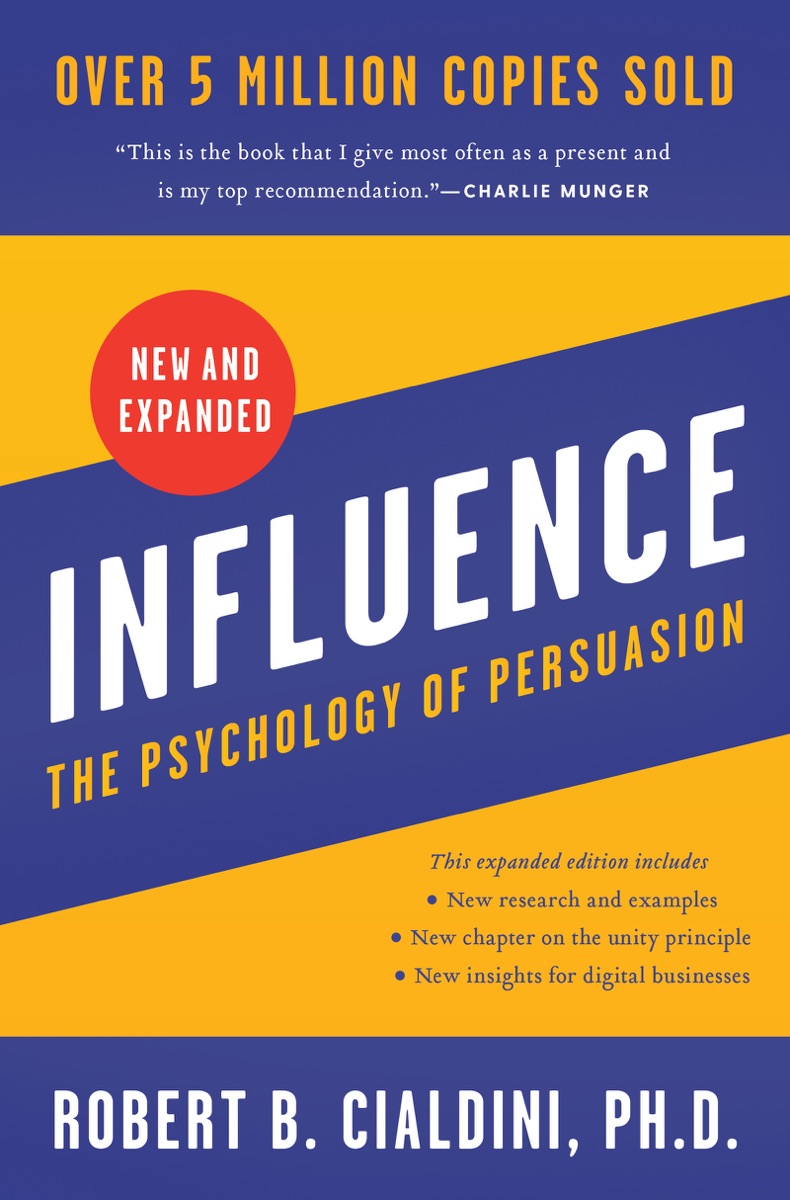
Influence: The Psychology of Persuasion
Robert B. Cialdini
My take
Most books about persuasion teach you how to sell. This one teaches you how you’re being sold to, constantly, by everyone, including yourself. Cialdini identifies six principles that drive human compliance, and the uncomfortable part isn’t learning that they exist. It’s recognizing how often you’ve already been on the receiving end without knowing it. I read this book as a marketer and left it thinking like a psychologist. The value isn’t in using the principles on other people. It’s in seeing them operate on you, so you can make decisions from actual judgment instead of automatic reflex. Once you know the triggers, you can’t unsee them, in ads, in negotiations, in friendships, in how you talk yourself into things you don’t actually want.
Core insight 1: We run on autopilot more than we think
Cialdini’s opening argument is that humans rely heavily on mental shortcuts. We don’t think through every decision. We use triggers: “expensive means good,” “if everyone’s doing it, it must be right,” “if they gave me something, I owe them.” These shortcuts are usually efficient and often harmless. The problem is that they can be exploited, and once you know the patterns, you start noticing how rarely you’re actually thinking.
A well-known principle of human behavior says that when we ask someone to do us a favor we will be more successful if we provide a reason. People simply like to have reasons for what they do.
How to practice: For one day, notice every decision where you rely on a shortcut instead of thinking it through. “I bought it because it was on sale.” “I agreed because they were nice.” Count them.
Core insight 2: Reciprocity is the oldest debt
When someone gives you something, you feel obligated to return the favor. This is universal, automatic, and deeply embedded. The gift doesn’t have to be large or even wanted. A free sample, an unsolicited compliment, a small concession in a negotiation. The rule of reciprocity kicks in before your rational mind catches up. Cialdini shows how this principle explains everything from Hare Krishna donations to supermarket taste tests.
The truly gifted negotiator, then, is one whose initial position is exaggerated enough to allow for a series of concessions that will yield a desirable final offer from the opponent, yet is not so outlandish as to be seen as illegitimate from the start.
How to practice: Next time you feel pressured to say yes, ask yourself: am I agreeing because I actually want this, or because I feel like I owe someone? If the answer is debt, pause.
Core insight 3: Commitment locks you in, consistency keeps you there
Once you take a stand, make a choice, or state a position publicly, something shifts. You start bending your future behavior to stay consistent with that commitment, even when it no longer makes sense. We don’t like contradicting ourselves. Cialdini shows how car dealers, cult leaders, and charity drives all exploit this, getting a small “yes” first and then escalating, knowing that your need for consistency will do the heavy lifting.
We all fool ourselves from time to time in order to keep our thoughts and beliefs consistent with what we have already done or decided.
Persons who go through a great deal of trouble or pain to attain something tend to value it more highly than persons who attain the same thing with a minimum of effort.
How to practice: Before defending a position or doubling down on a choice, ask: do I still believe this, or am I just being consistent with a version of myself that’s already moved on?
Core insight 4: We look to others when we don’t know what to do
Social proof is the principle that says: when we’re uncertain, we look at what everyone else is doing and assume it must be correct. It’s why laugh tracks work, why crowded restaurants feel safer, why “bestseller” badges sell more books. The more uncertain the situation, the stronger the pull. The more similar the other people are to us, the more we trust their behavior as a signal.
Since 95 percent of the people are imitators and only 5 percent initiators, people are persuaded more by the actions of others than by any proof we can offer.
In general, when we are unsure of ourselves, when the situation is unclear or ambiguous, when uncertainty reigns, we are most likely to look to and accept the actions of others as correct.
How to practice: Next time you base a decision on “everyone’s doing it,” stop and check: do you actually have information, or are you borrowing confidence from a crowd that might be just as lost?
Core insight 5: Liking is a weapon, and it’s invisible
We say yes to people we like. That’s obvious. What’s less obvious is how systematically liking can be manufactured. Physical attractiveness creates a halo effect. Similarity breeds trust. Compliments work even when we know they’re calculated. Association with good things (a celebrity endorsement, a sunny day during the sales pitch) transfers positive feelings to whatever is being sold. The scariest part: we rarely recognize liking as the reason we complied.
We like people who are similar to us. This fact seems to hold true whether the similarity is in the area of opinions, personality traits, background, or life-style.
There is a natural human tendency to dislike a person who brings us unpleasant information, even when that person did not cause the bad news. The simple association with it is enough to stimulate our dislike.
How to practice: When someone is unusually likeable in a transaction, that’s the moment to be most careful. Separate the person from the proposal. Ask: would I still want this if a stranger were offering it?
Core insight 6: Authority bypasses your judgment
A title, a uniform, a confident tone of voice. Authority signals short-circuit critical thinking. Cialdini cites study after study where people follow instructions from perceived authority figures even when the instructions are clearly wrong or harmful. We’re trained from childhood to defer to experts, and that training runs deep enough that the appearance of expertise is often enough.
Our best evidence of what people truly feel and believe comes less from their words than from their deeds.
How to practice: When an expert tells you something, ask: is this person an actual authority on this specific question, or do they just look like one? Credentials in one domain don’t transfer automatically to another.
Core insight 7: Scarcity makes you irrational
The moment something becomes scarce, limited, or about to disappear, it becomes more desirable. Not because its value changed, but because your fear of losing it overrides your ability to evaluate it clearly. “Limited time offer,” “only 3 left,” “this opportunity won’t come again.” Cialdini shows that scarcity doesn’t just increase desire. It actively impairs your ability to think about what you’re actually getting.
People seem to be more motivated by the thought of losing something than by the thought of gaining something of equal value.
When our freedom to have something is limited, the item becomes less available, and we experience an increased desire for it. However, we rarely recognize that psychological reactance has caused us to want the item more; all we know is that we want it.
How to practice: When you feel urgency, that’s the signal to slow down. Ask: would I want this just as much if it were freely available tomorrow? If not, the urgency is doing the selling, not the value.
This isn’t a book about being more persuasive, though it’ll make you that too. It’s a book about the invisible wires that pull your decisions in directions you didn’t choose. Once you see them, you can’t unsee them. And that awareness, the pause between the trigger and your response, is where real judgment lives.
Other reminders
Embarrassment is a villain to be crushed.
The way to love anything is to realize that it might be lost.
Often we don’t realize that our attitude toward something has been influenced by the number of times we have been exposed to it in the past.
Freedoms once granted will not be relinquished without a fight.
Civilization advances by extending the number of operations we can perform without thinking about them.
It is easier to resist at the beginning than at the end.
Apparently we have such an automatically positive reaction to compliments that we can fall victim to someone who uses them in an obvious attempt to win our favor.
Our typical reaction to scarcity hinders our ability to think.
Enjoyed this? You'll like Open Loops.
Every week I share ideas on clarity, growth, and building a life that feels like yours. Join 3K+ readers.
You might also like