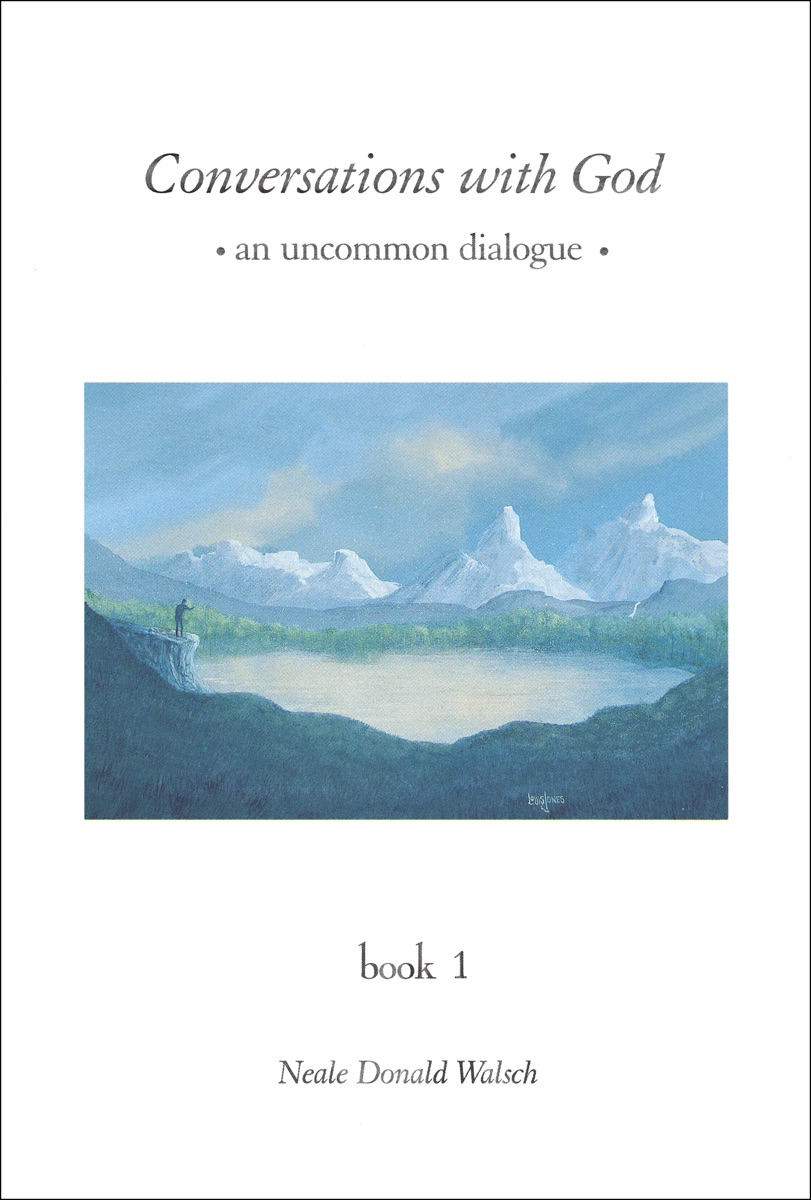
Conversations with God
Neale Donald Walsch
My take
The form of this book is strange enough that most people either bounce off it hard or surrender to it completely. Walsch claims he wrote it as a literal dialogue with God, questions in his hand, answers coming through the pen. Treat that framing however you need to. What I care about is the underneath. Strip the mystical packaging and what you get is one of the clearer theories I’ve read on why we suffer more than we need to, and how thought, word, and feeling conspire to create the life we are living. The single line that rearranged my thinking was this: what’s happening is merely what’s happening; how you feel about it is another matter. That is the whole book in miniature. Events are not pain. The verdict you attach to the event is pain. Strip the verdict and what’s left is just the thing, and the thing is usually survivable. From there, Walsch opens the same door from a dozen different angles: fear and love are the only two real emotions; your soul came to feel, not to know; the one question that answers every relationship dilemma is what would love do now; prayer works best as gratitude because wanting reinforces not having. The language is cosmic. The mechanics are ordinary and completely usable.
Core insight 1: Every human action traces back to one of two emotions
Walsch’s central claim is that all motivation reduces to fear or love. Every anger is fear wearing a sharper costume. Every generosity is love making itself visible. You cannot skip either feeling, but you can catch which one is running the show in a given moment and decide whether you want it to keep running.
All human actions are motivated at their deepest level by two emotions, fear or love. In truth there are only two emotions, only two words in the language of the soul.
Fear wraps our bodies in clothing, love allows us to stand naked. Fear clings to and clutches all that we have, love gives all that we have away. Fear holds close, love holds dear. Fear grasps, love lets go.
Thought is creative. Fear attracts like energy. Love is all there is.
How to practice: In the next decision that feels heavy, ask which of the two is driving. If fear is in the seat, the decision is about protecting something. If love is there, it’s about offering something. Neither is automatically wrong, but most of us mistake fear-driven action for wisdom far more often than we catch ourselves.
Core insight 2: Pain is judgment, not the event
This is the reframe that changed the temperature of my internal weather. What happens is neutral. The suffering lives in the verdict you lay on top of it. Remove the verdict and what remains is the thing, doing whatever it was doing, no longer capable of hurting you the way you were sure it would.
What’s happening is merely what’s happening. How you feel about it is another matter.
Pain results from a judgement you have made about a thing. Remove the judgement and the pain disappears.
This is not a denial of grief or injustice. Some events earn their weight. But most daily suffering is not earned. It is layered on by a mind that has been trained to assign meanings reflexively, and the meaning it assigns is almost always worse than the event deserved.
How to practice: When something stings, separate the two layers. What actually happened? What story am I telling about it? Sit with both on the table and ask honestly whether the story is doing useful work or just generating extra pain.
Core insight 3: The soul came to feel, not to know
This reframe dissolves a particular kind of modern anxiety, the sense that you are supposed to figure your life out. Walsch’s answer is that you already have the knowledge. What you don’t have yet is the felt experience of it. Life is not a puzzle to solve. It is an arena in which to experience what you conceptually already know about yourself.
Life is an opportunity for you to know experientially what you already know conceptually. You need learn nothing to do this. You need merely remember what you already know, and act on it.
The soul is after the feeling. Not the knowledge, but the feeling. It already has the knowledge, but knowledge is conceptual. Feeling is experiential.
Words may help you understand something. Experience allows you to know.
How to practice: Stop treating your life as a test you’re supposed to ace. Treat it as a place where the answers get felt. When you’re stuck, ask less “what’s the right choice” and more “what experience of myself am I trying to have next.” The second question usually knows the answer.
Core insight 4: Feeling is the language of the soul
If the soul is in the business of feeling, then your feelings are not noise to be managed. They are the channel through which you know what is true for you. When your thoughts and your feelings disagree, the feeling is usually closer to the truth than the thought has caught up to yet.
Feeling is the language of the soul.
If you want to know what’s true for you about something, look to how you’re feeling about it.
Feelings are sometimes difficult to discover, and often even more difficult to acknowledge. Yet hidden in your deepest feelings is your highest truth.
How to practice: The next time you are about to make a decision through sheer reasoning, pause and ask what is actually there underneath the analysis. The logic is usually arguing with a feeling that already knew. Let the feeling have a seat at the table before the thought wins on procedure.
Core insight 5: The only question that matters in a hard moment
Walsch offers one line for every relationship dilemma, every hard conversation, every decision where you’ve been stalling because the right move isn’t obvious. What would love do now. It is disarmingly simple and nearly always produces an answer you already knew but had been avoiding.
At the critical juncture in all human relationships, there is only one question: What would love do now? No other question is relevant, no other question is meaningful, no other question has any importance to your soul.
How to practice: Hold the question literally. In the tense text draft, the unsent email, the conversation you keep avoiding, ask what love would do here. Not what the smart move is. Not what the safe move is. What love would do. The answer usually arrives before you finish the question.
Core insight 6: Prayer as gratitude, not supplication
Every request carries a hidden premise. I do not have this. Repeat that premise long enough and the universe keeps producing the condition of not having it. The correct posture is thanks for what is already on the way. The hack is not in the words of the prayer. It is in the state you are praying from.
You will not have that for which you ask, nor can you have anything you want. This is because your very request is a statement of lack, and your saying you want a thing only works to produce that precise experience, wanting, in your reality.
The correct prayer is therefore never a prayer of supplication, but a prayer of gratitude.
When you thank God in advance for that which you choose to experience in your reality, you, in effect, acknowledge that it is there in effect.
How to practice: The next time you catch yourself wishing, rewrite the sentence as thanks. “I wish I had more clarity” becomes “thank you for the clarity that is on its way.” It feels contrived at first. Keep doing it. The framing changes what you notice.
Core insight 7: You are the creator; what is watching is the observer
The theological reframe at the spine of the book: God did not build your life. God built you, handed you free will, and is now watching. The life you are living is your creation. This is either terrifying or liberating depending on how much you wanted someone else to be responsible.
If you believe that God is the creator and decider of all things in your life, you are mistaken. God is the observer, not the creator.
You are the creator of your reality, and life can show up no other way for you than that way in which you think it will.
Each event and adventure is called to your Self by your Self in order that you might create and experience Who You Really Are.
How to practice: Name one thing you’ve been waiting for an external rescue on. Identify the agency you have that you have not been using. Start with the smallest move. The rescue you were waiting for was the permission you hadn’t given yourself.
Walsch packages this as mysticism, but the mechanics are ordinary. Fear and love are the only two motivations, and most of the time fear is pretending to be wisdom. Pain is a verdict you keep laying on top of events that were neutral until you touched them. Your soul came to feel what you already know, not to add more information. And the life you keep waiting for someone else to arrange is already waiting on you to make the next move.
Other reminders
Enlightenment is understanding that there is nowhere to go, nothing to do, and nobody you have to be except exactly who you’re being right now.
True masters are those who’ve chosen to make a life rather than a living.
Death is never an end, but always a beginning. A death is a door opening, not a door closing.
If you do not go within, you go without.
A true Master does not give up something. A true Master simply sets it aside, as he would do with anything for which he no longer has any use.
Emotion is energy in motion. When you move energy, you create effect. If you move enough energy, you create matter.
Passion is the path. It is the way to Self-realization. If you have a passion for nothing, you have no life at all.
People are constantly changing and growing. Do not cling to a limited, disconnected, negative image of a person in the past.
Nothing in this universe occurs by accident.
Enjoyed this? You'll like Open Loops.
Every week I share ideas on clarity, growth, and building a life that feels like yours. Join 3K+ readers.
You might also like