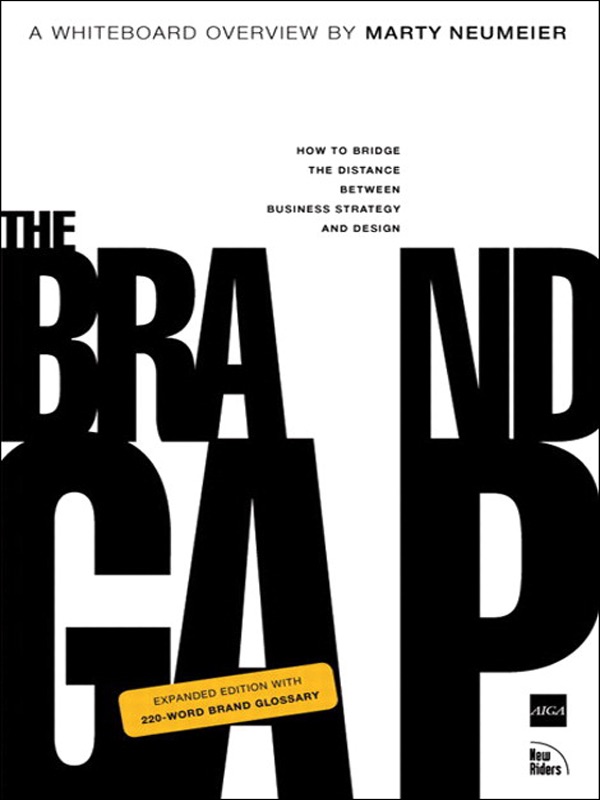
The Brand Gap
Marty Neumeier
My take
I spent a decade getting paid to think about brand. Most of what I was hired to do was not design work or messaging work, it was translation work: the company knew what it meant, and the market heard something else, and my job was to close the distance between the two. That distance is what Neumeier calls the gap. His thesis is disarmingly simple. Strategy comes from the left brain. Creativity comes from the right. Brands that feel strong are the ones where those two sides are actually talking to each other. Brands that feel confused, bloated, or forgettable are the ones where they are not. Once you see this framing you cannot unsee it. Every rebrand I have ever watched go sideways was a gap problem. Either the strategy was so abstract it couldn’t be designed, or the design was so pretty nobody could remember what it was for. What I love about this book is how short it is. Neumeier walks you through the entire operating system of a modern brand in about two hours. Read it once in an afternoon, keep it on your shelf, and steal from it for the rest of your career.
Core insight 1: A brand does not live inside your company
The single most important shift for anyone working on brand is this. Your brand is not what your deck says it is. Your brand is the feeling that lands in the head of a specific person when they encounter you. You can shape that feeling. You cannot dictate it. The companies that keep trying to dictate are the ones where the gap gets worse every year.
A brand is not a logo. A brand is not a corporate identity system. It’s a person’s gut feeling about a product, service, or company.
Good branding makes business integral to society and creates opportunity for everyone, from the chief executive to the most distant customer.
How to practice: Before your next brand conversation, stop asking what you want to say about yourselves and start asking what specific feeling you want to leave behind in a specific person’s head. The first question is infinite and self-referential. The second one you can actually design for.
Core insight 2: Three questions organize everything
Neumeier’s simplest tool is the one I’ve used most. Any brand, any product, any person, answers three questions. Who are you. What do you do. Why does it matter. If the answers don’t line up, no amount of design work will save you. If they do, no amount of bad design can sink you.
Who are you? What do you do? Why does it matter?
The third question is the one most companies fail. They nail the who and the what, and then the why becomes a slogan instead of a reason. A real answer to why it matters is not marketing copy. It is a sentence the founder actually believes, and would keep believing if nobody was paying attention.
How to practice: Write your own three answers on a blank page, no templates. Do it for the company, then do it for yourself. The ones you can say out loud without flinching are the real ones. The rest is still cosplay.
Core insight 3: Intuition beats market research when the idea is big enough
Most brand work gets flattened by research. The research asks customers what they want, and customers answer with what they already know, which by definition cannot include the thing you have not shown them yet. Ford got it right. The phrase that still rings decades later.
If we had asked the public what they wanted, they would have said ‘faster horses.’
Research is useful for confirming the fit of an execution. It is terrible at telling you what to build. The reason Apple, Dyson, and IKEA look obvious in retrospect is that the founder had enough conviction to get past the research phase without selling the soul of the idea.
How to practice: Use research to sharpen a direction you already have intuition about. Do not use it to decide the direction. The first is listening. The second is outsourcing your judgment to people who have never worked on your problem.
Core insight 4: Aesthetics is not decoration, it is the language of feeling
This is the one that converts skeptical operators. In an information-rich, time-poor world, people do not have the bandwidth to parse your value prop paragraph. They have a half-second to decide whether you feel trustworthy, premium, human, or hostile. That decision happens in the body, not the mind, and aesthetics is the channel it runs on.
A charismatic brand includes a dedication to aesthetics. Why? Because it’s the language of feeling, and in a society that’s information-rich and time-poor, people value feeling more than information.
If your founders think design is the pretty part at the end, you will end up with a company that feels generic no matter how good the product is. Aesthetic taste is strategic infrastructure. It deserves the same investment as the tech stack.
How to practice: Look at your homepage, your email footer, your first slide, your office. Not at what they say. At what they feel like. If the feeling does not match what you want to be known for, you have a gap, and aesthetics is where you close it.
Core insight 5: Every brand expression gets judged on five things
Neumeier gives you a scorecard that is surprisingly durable. Run any piece of brand work through it before you ship. Distinctiveness. Relevance. Memorability. Extendibility. Depth. If it fails two or more, rework it. Most committees ship work that is relevant but not distinctive, or memorable but not extendible. The scorecard surfaces the tradeoffs fast.
Distinctiveness is the quality that causes a brand expression to stand out from competing messages. If it doesn’t stand out, the game is over.
Relevance asks whether a brand expression is appropriate for its goals.
Memorability is the quality that allows people to recall the brand or brand expression when they need to.
Extendibility measures how well a given brand expression will work across media, across cultural boundaries, and across message types.
Depth is the ability to communicate with audiences on a number of levels.
How to practice: Before signing off on a campaign, a logo, a homepage, or a product name, rate it one through five on each of the criteria. Write the numbers down. If the lowest two are under a three, keep working. This tiny ritual saves you from launching things you’ll want to replace six months later.
Core insight 6: Subtraction is a skill almost nobody builds
The instinct in most companies is to add. Add a feature, add a message, add a sub-brand, add a product line. The instinct in great brands is to subtract. Strip, simplify, refuse, narrow. Taking things out is harder than putting things in, which is why most teams default to addition even when it’s killing them.
The ability to subtract features is the rare gift of the true communicator.
Jobs said it. Neumeier says it. Every designer you respect says it. The hard part is that subtracting feels like losing in real time. You only find out it was right when the thing you shipped feels sharp, fast, and obvious.
How to practice: On your next brand deck, project, or launch, force a round of subtraction before you ship. Make yourself remove three things. Pages. Slides. Features. Lines of copy. If the work gets worse, put them back. If it gets better, you had too much to begin with.
Core insight 7: Authenticity is the match between inside and outside
Brand is not the costume you wear. Brand is what happens when the inside and outside are doing the same thing. If your internal culture is hierarchical and your external voice is playful, you will feel fake even if every ad is gorgeous. Customers sense this fast. Employees sense it faster.
When the external actions of a company align with its internal culture, the brand resonates with authenticity.
The reason most rebrands fail is that they rebrand the outside and leave the inside untouched. The best brand work I have ever seen started inside. The external expression was just the part the public could finally see.
How to practice: If your brand feels off, resist the urge to redesign the surface. Interview ten people inside the company. Ask what they think the company really is. The gap between their answers and the external story is the real work.
Neumeier’s whole book is a long argument against treating brand as decoration. A brand is a promise with visual evidence attached. The companies that win the next decade are the ones where strategy and creativity stop living in separate rooms. If you work anywhere near founders, product, marketing, or design, read this once, then re-read the five-criteria scorecard every time you’re about to ship something you’re not sure about.
Other reminders
If we wipe away some of the misconceptions about brand, we can make more room for its truths.
A brand is a person’s gut feeling about a product, service, or company.
Who are you? What do you do? Why does it matter?
The ability to subtract features is the rare gift of the true communicator.
People value feeling more than information.
When the external actions of a company align with its internal culture, the brand resonates with authenticity.
If it doesn’t stand out, the game is over.
Enjoyed this? You'll like Open Loops.
Every week I share ideas on clarity, growth, and building a life that feels like yours. Join 3K+ readers.
You might also like