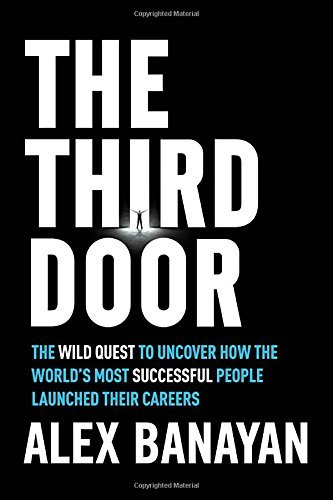
The Third Door
Alex Banayan
My take
I read this during a stretch where I kept waiting for the right moment to make moves. Waiting for enough experience, enough credentials, enough proof that I was “ready.” Banayan’s story snapped me out of it. He was a college freshman who decided to track down Bill Gates, Warren Buffett, Lady Gaga, Maya Angelou, and dozens of others to learn how they broke through. He had no connections, no platform, nothing except the nerve to start. The premise is simple: there are always three doors to any opportunity. The First Door is the main entrance where everyone waits in line. The Second Door is the VIP entrance for the privileged few. And the Third Door is the one you find by going around back, climbing through a window, picking a lock. Every person he interviewed got where they were not by following the prescribed path, but by refusing to wait for permission. That pattern hit me harder than any single piece of advice in the book. You can just do things. You don’t need anyone’s sign-off to begin.
Core insight 1: There is always a third door
Most people stand in line at the First Door and hope their turn comes. Some are born close to the Second Door and walk right in. But there is always a Third Door. And the people who find it share one quality: they refuse to accept that the obvious path is the only path.
All the people I’d interviewed treated life, business, and success the same way. In my eyes, it was like getting into a nightclub. There are always three ways in.
Everyone has the power to make little choices that can alter their lives forever. You can either choose to give in to inertia and continue waiting in line for the First Door, or you can choose to jump out of line, run down the alley, and take the Third Door.
How to practice: Next time you hit a locked door, stop pushing harder and look sideways. Ask: who already has access? What would an outsider with nothing to lose try? What angle hasn’t been explored? The constraint isn’t the door. It’s the assumption that there’s only one.
Core insight 2: Opt into an exponential life
Society sells you a linear path: get the degree, pay your dues, climb the ladder, and eventually, years from now, you’ll earn the right to do what you actually want. Banayan’s interviews revealed a completely different pattern. The people who built extraordinary lives skipped steps. Not because they were reckless, but because they refused to accept someone else’s timeline.
But successful people don’t buy into that model. They opt into an exponential life. Rather than going step by step, they skip steps. People say that you first need to ‘pay your dues’ and get years of experience before you can go out on your own and get what you truly want. Society feeds us this lie that you need to do x, y, and z before you can achieve your dream. It’s bullshit. The only person whose permission you need to live an exponential life is your own.
How to practice: Look at whatever you’re putting off until you feel “ready.” Ask yourself: is there a version of this I could start today, even if it’s rough and unpolished? The linear path feels safe because it’s crowded. The exponential path feels reckless because it’s empty. But the emptiness is the point.
Core insight 3: Naivety is an advantage
If Banayan had fully understood how impossibly difficult his quest would be, he never would have started. That ignorance is what kept him moving. Knowing too much can be the thing that stops you.
If I’d known then how my journey would unfold, how beaten and broken I’d soon find myself, I may never have started. But that’s the upside of being naive.
Having a teacher or boss tell you what to do makes life a lot easier. But nobody achieves a dream from the comfort of certainty.
The experienced voice in your head that says “be realistic” is often just fear wearing a suit. Sometimes the smartest thing you can do is not calculate the odds.
How to practice: When you catch yourself researching every possible risk before starting something, notice that impulse. Ask whether the research is serving the work or protecting you from it. Give yourself permission to begin before you have the full picture. The picture fills in as you move.
Core insight 4: Reframe the problem
One of the sharpest moves in the book is when Banayan realizes he’s been trying to get Warren Buffett to sit down for a private interview and getting nowhere. Instead of pushing harder, he restates the question entirely. What if I don’t need a private meeting? What if I just need my questions answered, however and wherever that happens?
I’d been focused on how to get Buffett to sit with me for a one-on-one interview. But what if I restated the problem? What if I just wanted Buffett to answer a few of my questions, no matter how or where he answered them?
This pattern shows up everywhere in the book. When a door is locked, the successful people don’t bang harder. They ask a different question.
Although people won’t meet with you for the reason you want, that doesn’t mean they won’t meet at all. Just find another angle. Figure out what they need and use that as your way in.
How to practice: When you’re stuck, write down the exact thing you’re trying to accomplish. Then rewrite it three different ways. Often the version of the problem you started with is too narrow. The reframe is where the Third Door appears.
Core insight 5: The pipeline is the strategy
Elliott Bisnow, who built Summit Series and sold Bisnow Media for fifty million dollars, didn’t have some master plan. He had a pipeline. He cold-emailed, made connections, showed up, offered value, and kept doing it until the compounding kicked in.
Immediate action was at the core of Elliott’s life. That, plus relentless hard work, added up over time.
The part that stuck with me is when Elliott explains why a pipeline works. Banayan had cold-emailed him a year and a half earlier asking for advice. What Banayan didn’t know was that Elliott had just made it his New Year’s resolution to find someone to mentor.
You want to know why a pipeline works? A year and a half ago, when you first cold-emailed me asking for advice, you didn’t know that a month earlier I’d made it my New Year’s resolution to find someone to mentor.
Luck isn’t random. It’s the result of putting yourself in enough rooms, enough times, that the timing eventually lines up.
How to practice: Stop waiting for the perfect opportunity and start building a pipeline of small, consistent actions. Send the email. Make the ask. Show up where the people you admire spend time. You won’t know which one will land. That’s the point.
Core insight 6: Read the footnotes
Buffett’s edge isn’t genius. It’s obsessive diligence while everyone else skims.
When everyone else skims a report, Buffett is obsessively scouring the fine print, going above and beyond, studying every word, looking for clues. You don’t have to be born a genius to read the footnotes. It’s a choice. It’s a choice to put in the hours, go the extra mile, and do the things others aren’t willing to do.
This one is deceptively simple. Most advantages aren’t about talent or connections. They come from doing the unglamorous work that everyone else considers beneath them. The footnotes are a metaphor for care itself.
I insist on a lot of time being spent, almost every day, to just sit and think. That is very uncommon in American business. So I do more reading and thinking, and make fewer impulse decisions than most people in business.
How to practice: Pick one area of your work where you’ve been skimming and go deeper. Read the source material. Study what others gloss over. The edge is almost always in the details nobody else bothered with.
Core insight 7: Think for yourself
Most people never stop to ask why they’re doing what they’re doing. They follow the default script: the degree, the career track, the milestones everyone else is chasing. The people Banayan interviewed all shared one trait. They questioned the script.
Most people do things because that’s what society tells them they should do. But if you stop and do the math, if you actually think for yourself, you’ll realize there’s a better way to do things.
Most people never take the time to ask themselves why they’re doing what they’re doing. And even when they do, most people lie to themselves.
Wozniak built what he wanted to build. Gaga broke every expectation. Buffett sat and thought while everyone else rushed. The pattern is the same: they defined their own scorecard.
How to practice: Set aside thirty minutes this week with no inputs. No phone, no podcast, no agenda. Just the question: am I doing what I’m doing because I chose it, or because it was the next thing on the default path? The answer changes everything.
Core insight 8: Genius is the opposite of expectation
This line from the founder of TED shows up twice in the book, and it stuck with me both times. The people who leave a mark are the ones who zig when everyone zags.
Genius is the opposite of expectation.
Lady Gaga’s entire career is built on defying what people think is coming next. The same principle applies to business, to creativity, to life. When you do what’s expected, you disappear into the crowd. When you surprise, you become memorable.
But what your story is about isn’t as important as how you tell it.
How to practice: Look at what you’re building, writing, or creating. Ask: is this what everyone else in my space would do? If yes, that’s your signal to find the unexpected angle. The Third Door is always where people aren’t looking.
The book ends where it begins: with a kid who had no business doing what he did, and did it anyway. That’s the real lesson. Not the celebrity wisdom, not the strategies, not the borrowed credibility playbook. It’s the simple, stubborn belief that you’re allowed to try. You don’t need someone to open the door for you. You just need the nerve to go looking for one nobody else noticed.
Other reminders
Excitement is the more practical synonym for happiness, and it is precisely what you should strive to chase.
Luck is like a bus. If you miss one, there’s always the next one. But if you’re not prepared, you won’t be able to jump on.
Desperation clogs intuition.
Big decisions are rarely clear when you’re making them. They’re only clear looking back. The best you can do is take one careful step at a time.
I live my life by two mantras. One: if you don’t ask, you don’t get. And two: most things don’t work out.
Everybody has experiences in their lives. Some choose to make them into stories.
Bite off more than you can chew. You can figure out how to chew later.
No matter how great the talent or effort, some things just take time. You can’t produce a baby in one month by getting nine women pregnant.
I’ve learned that while you can give someone all the best knowledge and tools in the world, sometimes their life can still feel stuck. But if you can change what someone believes is possible, their life will never be the same.
Enjoyed this? You'll like Open Loops.
Every week I share ideas on clarity, growth, and building a life that feels like yours. Join 3K+ readers.
You might also like