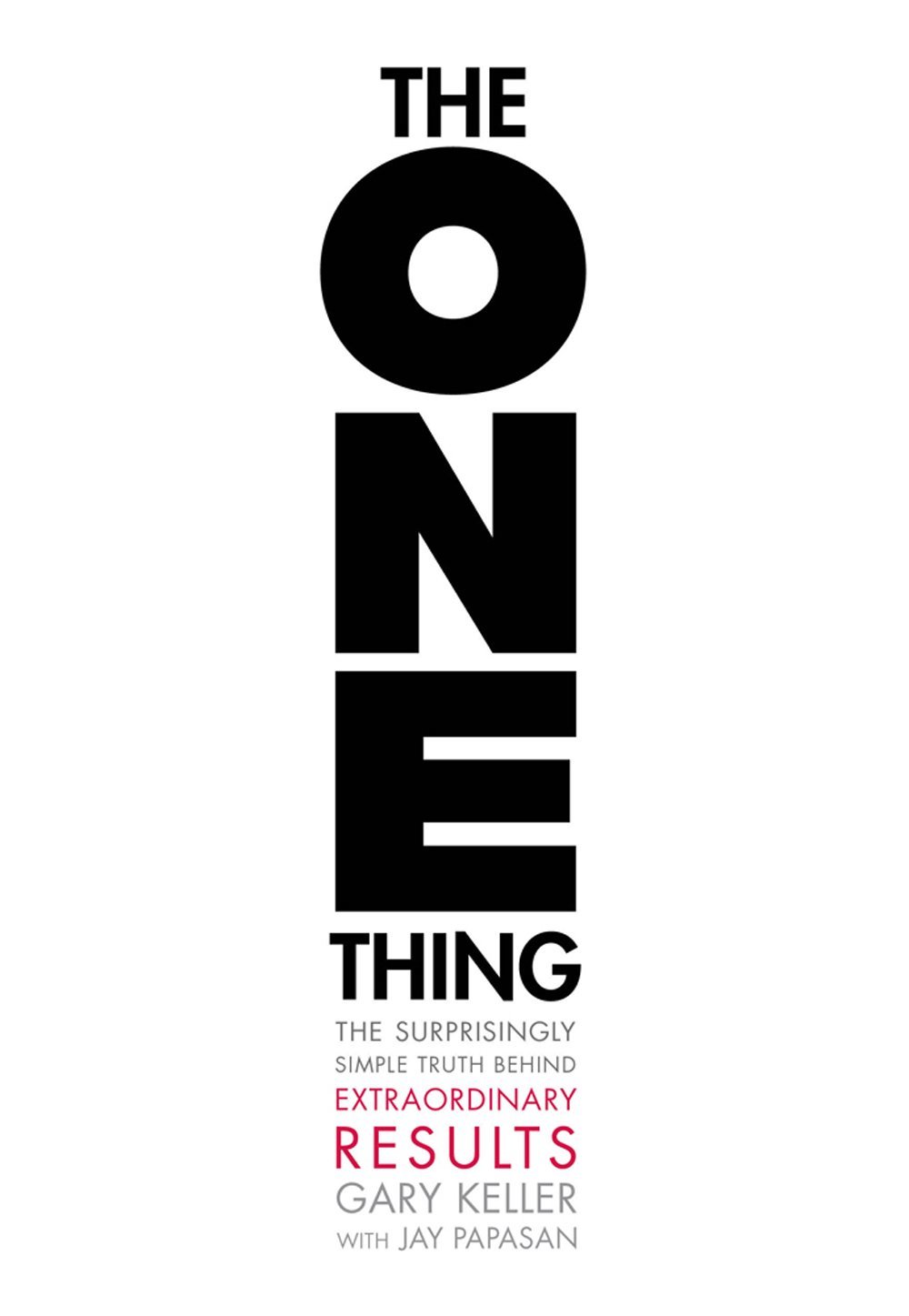
The One Thing
Gary Keller and Jay Papasan
My take
Most productivity books give you more to do. This one strips you down to one. Keller’s whole argument is built around a single question that he calls the focusing question: what is the one thing I can do such that by doing it, everything else becomes easier or unnecessary? It sounds simple until you actually try to answer it. The first few attempts produce vague nonsense. The good answers feel uncomfortably specific. Reading this book in a season where I had been spinning on too many initiatives at once was a course correction. Most of what I was working on was not load-bearing. The lever was in one place and I was applying force in twelve. I now use the focusing question almost weekly. It’s the single most useful frame I’ve borrowed from any business book.
Core insight 1: The focusing question is the whole book
Everything else flows from this one question, and most people never ask it of themselves. Not “what should I do today” but “what is the one thing that, if I did it, would make most of my other to-dos irrelevant?” The question forces you to think in cascades, not lists. The answer is almost never the thing you were already planning to do.
What’s the ONE Thing I can do such that by doing it everything else will be easier or unnecessary?
How to practice: Ask the focusing question on three timescales: this week, this quarter, this year. Write the three answers down. If they don’t match what’s currently on your calendar, your calendar is wrong.
Core insight 2: Extraordinary results come from saying no, a lot
Keller’s reframe of focus is the cleanest I’ve read. Focus is not about deciding what to do. It’s about deciding what not to do. Steve Jobs cut Apple from 350 products to 10 when he returned in 1997. That’s 340 noes. The point isn’t austerity. It’s that every yes to something off-purpose is a no to your one thing.
Focusing is not about saying yes. Focusing is about saying no.
When you say yes to something, it’s imperative that you understand what you’re saying no to.
How to practice: This week, audit every commitment on your calendar. For each one, ask: is this connected to my one thing? If not, find a way to decline it, defer it, or hand it off.
Core insight 3: Success is sequential, not simultaneous
The myth of the high performer is that they do everything at once. Keller’s research finds the opposite. Extraordinary results come from doing one thing at a time, in the right sequence. Master the first domino, then the next. The dominoes are sized correctly only when you stop trying to push them all at once.
The key is over time. Success is built sequentially. It’s one thing at a time.
Extraordinary success is sequential, not simultaneous.
How to practice: Stop trying to fix five things this quarter. Pick one. The other four will wait. They were going to wait anyway. The only question is whether they wait while you build leverage or while you stay average at all of them.
Core insight 4: Imbalance is the price of meaningful work
This was the most counterintuitive frame for me. Our culture worships balance. Keller pushes back: anything that matters requires you to be deliberately out of balance for stretches. The artist working on a piece. The founder shipping a product. The parent in the early years with a newborn. The work isn’t to maintain balance, it’s to choose your imbalances and then return.
When we say we’re out of balance, we’re usually referring to a sense that some priorities, things that matter to us, are being underserved or unmet.
The problem is that when you focus on what is truly important, something will always be underserved. No matter how hard you try, there will always be things left undone at the end of your day, week, month, year, and life.
How to practice: Stop trying to be perfectly balanced. Pick the area you’re going to deliberately over-invest in for the next quarter. Tell the people in the under-served areas what you’re doing and why. Return when you’re done.
Core insight 5: Time-block your one thing first
The single most actionable habit in the book. Most people fit their one thing in around the edges of their calendar, which means it never gets done. Keller’s prescription: block the time for your one thing first, before everything else. Put it in the morning when your energy is highest. Defend it like an important meeting. Then let the rest of the day fill in around it.
Time blocking harnesses your energy and focuses it on your most important work. It’s productivity’s holy grail.
How to practice: Tomorrow morning, before opening email or messages, spend 90 minutes on your one thing. Make this non-negotiable for the next month. Watch what changes.
Core insight 6: Your environment will out-vote your willpower
Keller’s data here is sobering. Your physical surroundings and the people you spend time with will shape your behaviour more reliably than any goal you set. Willpower is a depleting resource. Environment is a permanent one. So instead of trying to be more disciplined, redesign the room and the relationships.
Your environment is simply who you see and what you experience every day. The people are familiar, the places comfortable.
Your environment must support your goals.
How to practice: Look at your top three goals. Then look at your top three relationships and your default work setup. Are they aligned? If not, the goals will lose. Adjust the environment, not the willpower.
Core insight 7: Passion compounds into mastery
Keller flips the standard order. We’re told to “find your passion” first and then build skill. He argues the reverse: start where you have some pull, put in the time, get good, get better results, enjoy it more, put in more time. The flywheel runs the other direction from how it’s usually taught.
Passion for something leads to disproportionate time practicing or working at it. That time spent eventually translates to skill, and when skill improves, results improve. Better results generally lead to more enjoyment, and more passion and more time is invested.
How to practice: Stop waiting to feel passionate before you commit. Pick the thing you have most pull toward right now and put in 90 minutes a day for 90 days. Re-evaluate then.
Core insight 8: Live to minimise your future regrets
The last chapter ties the whole book to mortality. The deathbed studies are consistent across cultures: the most common regret is not having lived more authentically. Keller’s framing of the focusing question becomes existential at the end. The one thing isn’t just about productivity. It’s about the life you’ll have lived.
Twenty years from now you will be more disappointed by the things that you didn’t do than by the ones you did do.
Go live a life worth living where, in the end, you’ll be able to say, “I’m glad I did,” not “I wish I had.”
How to practice: Imagine yourself at eighty looking back at this year. What would you regret not having done? That’s your one thing.
A short, opinionated book that has become one of my most-referenced. Most of it can be reduced to two moves: ask the focusing question often, and protect time for the answer. Do those two things and the rest takes care of itself.
Other reminders
Anyone who dreams of an uncommon life eventually discovers there is no choice but to seek an uncommon approach to living it.
The prescription for extraordinary results is knowing what matters to you and taking daily doses of actions in alignment with it.
One-half of knowing what you want is knowing what you must give up before you get it.
Focus is a matter of deciding what things you’re not going to do.
Hanging out with people who seek success will strengthen your motivation and positively push your performance.
The single most important difference between amateurs and elite performers is that the elite seek out teachers and coaches and engage in supervised training, whereas the amateurs rarely engage in similar types of practice.
The battle is between two wolves inside us. One is Fear. The other is Faith. Which wolf wins? The one you feed.
The purpose of life is to be useful, to be responsible, to be compassionate. It is, above all, to matter, to count, to stand for something, to have made some difference that you lived at all.
Enjoyed this? You'll like Open Loops.
Every week I share ideas on clarity, growth, and building a life that feels like yours. Join 3K+ readers.
You might also like